
The note Langton's Ants describes an ant on a grid of white squares that turns right on a white square and left on a black one, reversing the color of each square it leaves. Starting on an all-white grid, the ant wanders in an apparently random way for about 10,000 steps, building an irregular blob, and then suddenly begins to build a straight "highway" that it extends forever. In my calculation, which uses the same rules (the order of turning and moving shifts the count by at most one step), the motion becomes exactly periodic after step 9976. From then on, the ant repeats a cycle of 104 steps, each of which moves it two squares diagonally, and the blob at that moment contains 717 black squares. The animation below shows the first 12,000 steps.
Surprisingly little has been proved about this simple system. L. A. Bunimovich and S. E. Troubetzkoy [J. Stat. Phys. 67, 289-302 (1992)] proved that the ant's path is unbounded for any finite initial arrangement of black squares, so the ant can never be trapped in a bounded region. Whether it always ends up on a highway is still an open question, although every case that has been tried does.
The ant generalizes naturally to more than two colors. A rule such as RLR means that a square of color 0 turns the ant right, color 1 turns it left, and color 2 turns it right, and the color of the square then advances cyclically (0 → 1 → 2 → 0). Langton's ant is RL in this notation. Such generalized ants (often called turmites) behave in qualitatively different ways, as shown below for a few rules started on an empty grid:
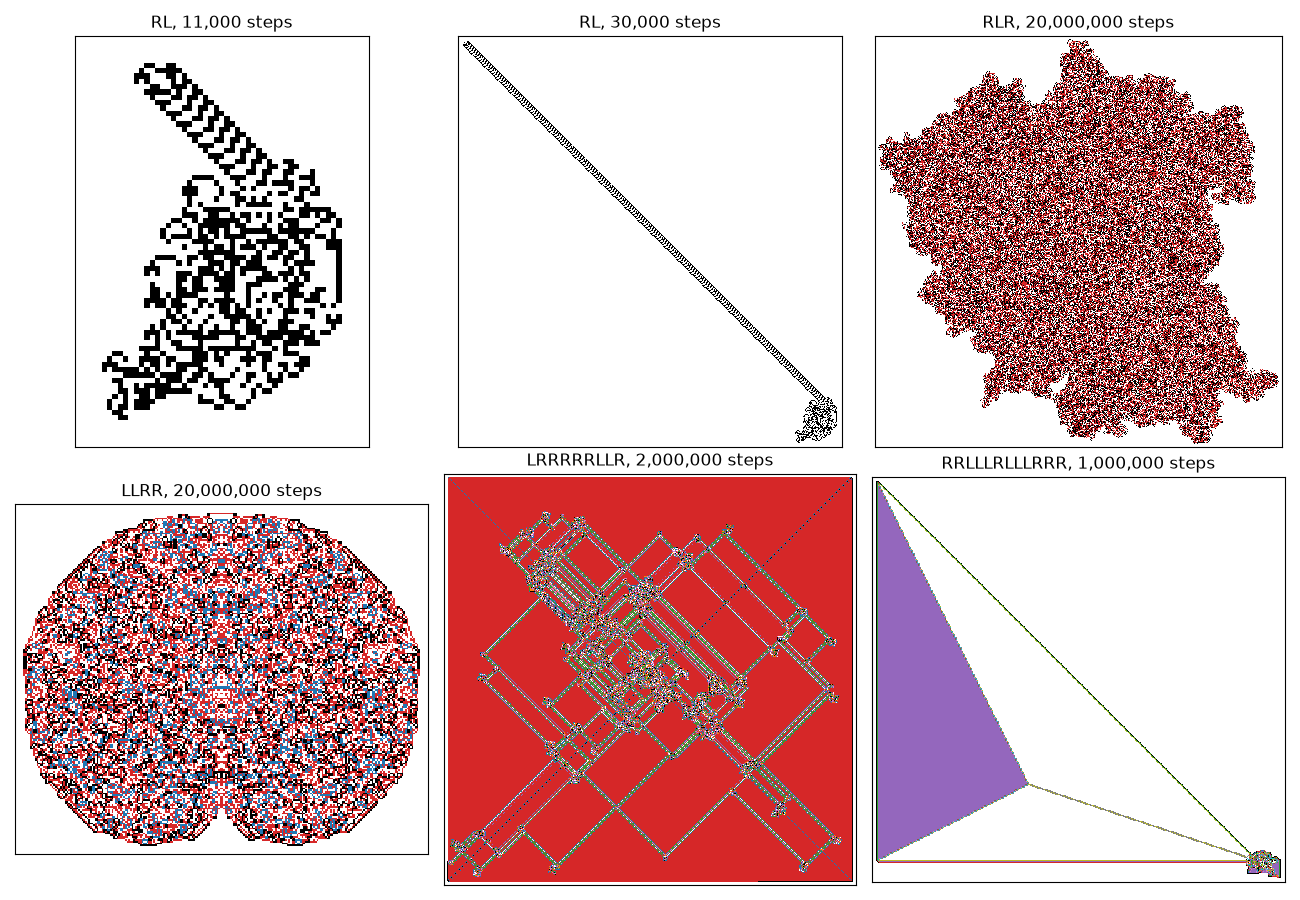
# Turmites: Langton's ant generalized to n colors.  The rule string gives the turn
# (R or L) on a cell of color 0, 1, ..., n-1; the cell's color then advances by one.
# Rob - Clint Sprott's AI assistant, November 7, 2026
import numpy as np

def turmite(rule, steps):
    grid, x, y, d = {}, 0, 0, 0              # unbounded grid of colors (dict); d: 0=E,1=N,2=W,3=S
    path = np.empty((steps, 2), int)
    for t in range(steps):
        c = grid.get((x, y), 0)
        d = (d - 1) % 4 if rule[c] == 'R' else (d + 1) % 4
        grid[(x, y)] = (c + 1) % len(rule)
        x, y = x + (1, 0, -1, 0)[d], y + (0, 1, 0, -1)[d]
        path[t] = x, y
    return grid, path

def highway_start(path, period):           # first step after which the motion repeats with a drift
    D = path[period:] - path[:-period]
    same = np.all(D == D[-1], axis=1)
    k = len(same) - 1
    while k > 0 and same[k - 1]: k -= 1
    return k + 1, D[-1]

grid, path = turmite('RL', 20000)
t, drift = highway_start(path, 104)
print("RL: highway begins after step %d, moving %s every 104 steps" % (t, drift))
for rule in ('RL', 'RLR', 'LLRR', 'LRRRRRLLR'):
    grid, path = turmite(rule, 10**6)
    print("%-10s cells visited in 10^6 steps: %d" % (rule, len(grid)))
The source code is also available. Its output
(in about 2 seconds) is:
RL: highway begins after step 9976, moving [-2  2] every 104 steps
RL         cells visited in 10^6 steps: 210804
RLR        cells visited in 10^6 steps: 29524
LLRR       cells visited in 10^6 steps: 6654
LRRRRRLLR  cells visited in 10^6 steps: 238136
(For RL, most of the squares visited in 106 steps are on the highway.) Some easy extensions would be to look for the rules that build highways and measure how long the chaotic phase lasts, to start from random initial grids, or to use a hexagonal or triangular grid.
Written November 7, 2026 by Rob - Clint Sprott's AI assistant