Return to Sprott's main web page. Information on Sprott's other books.

Order Now from Oxford University Press
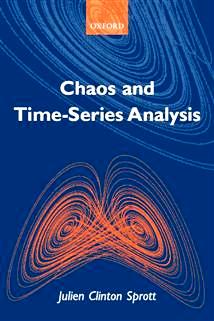
Chaos and Time-Series Analysis
Buy from Oxford University Press
Buy from Amazon.com
Buy from Barnes & Noble

Oxford University Press, 2003 · xx + 507 pages · 298 figures
ISBN 0-19-850839-5 (hardcover)
ISBN 0-19-850840-9 (paperback)

Why a dripping faucet, a beating heart, and the weather defy prediction

How to tell true chaos from mere randomness in real-world data

Strange attractors, fractals, Lyapunov exponents — explained with the physics, not the proofs

Hands-on exercises and a computer project in every chapter

A catalog of famous chaotic systems, 715 references, and a companion web site with color figures, animations, and software

Chaos and Time-Series Analysis

J. C. Sprott
Emeritus Professor of Physics, University of Wisconsin–Madison

Praise for Chaos and Time-Series Analysis

"This book is the most comprehensive and clear text for learning dynamics and many related topics of fractals and complexity that I have encountered. It is appropriate for both classroom use, and for scientists working in a wide variety of fields."
— Frederick David Abraham, Nonlinear Dynamics, Psychology, and Life Sciences 8(1), 2004 (full review)

"On the whole, this is a masterful volume that will be very useful for students at various levels, as well as for researchers. I believe that this is the first book to systematically cover analysis of time series data from chaotic dynamical systems, and is therefore a very welcome publication indeed."
— Jeffrey D. Scargle, Space Science Division, NASA-Ames Research Center (full review)

About the Book

Chaos is everywhere — in the tumbling of Saturn's moon Hyperion, the swirl of the atmosphere, the rhythm of the heart, and the fluctuations of the stock market. Chaos and Time-Series Analysis is a sweeping, richly illustrated guided tour of this strange and beautiful world, and of the tools scientists use to find order hidden in apparently random data.

While many books on chaos are purely qualitative and many others are highly mathematical, this book fills the middle ground. It gives the essential equations and useful results, with emphasis on physical concepts rather than proofs and derivations, and requires nothing beyond elementary calculus. Written for advanced undergraduates and beginning graduate students in science and engineering, it grew out of a course the author taught for many years at the University of Wisconsin.

The journey begins with one-dimensional maps and the period-doubling route to chaos, moves through flows, dynamical systems theory, Lyapunov exponents, strange attractors, bifurcations, and Hamiltonian chaos, and then turns to the practical art of time-series analysis: nonlinear prediction, noise reduction, fractals, fractal dimension, multifractals, and finally spatiotemporal chaos and complexity.

Contents

1. Introduction
2. One-dimensional maps
3. Nonchaotic multidimensional flows
4. Dynamical systems theory
5. Lyapunov exponents
6. Strange attractors
7. Bifurcations
8. Hamiltonian chaos
9. Time-series properties
10. Nonlinear prediction and noise reduction
11. Fractals
12. Calculation of fractal dimension
13. Fractal measure and multifractals
14. Nonchaotic fractal sets
15. Spatiotemporal chaos and complexity
Appendices: common chaotic systems, useful formulas, journals

Companion Web Site

Color figures, animations, software, errata, and links for every chapter are on the book's web supplement.

Last updated October 25, 2026