Order Now from World Scientific
 Buy from World Scientific
Buy from Amazon.com
Buy from Barnes & Noble
World Scientific, 2026 · xii + 313 pages
ISBN 978-981-98-3816-5 (hardcover)
Fifty of the most beautiful and powerful ideas in science, from Occam's Razor to Pascal's Wager
Why symmetry implies conservation laws, why time has an arrow, and how mathematics predicted antimatter
Chaos, fractals, cellular automata, self-organized criticality and the Game of Life
Evolution, cooperation, Nash equilibrium, free will and the simulation hypothesis
Short, heavily illustrated chapters written for students, researchers and the simply curious
|
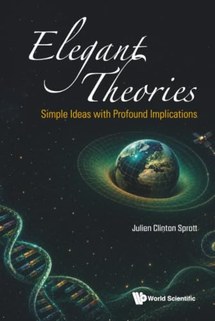
Elegant Theories
Simple Ideas with Profound Implications
J. C. Sprott
Emeritus Professor of Physics, University of Wisconsin–Madison
About the Book
This book is about fifty of the most beautiful and powerful theories in science — from Occam's Razor to Pascal's Wager — showing how simple ideas unlock profound truths. In each accessible and heavily illustrated chapter, J. C. Sprott reveals how strikingly simple concepts can unlock profound truths about the universe and our place in it — from the intimate link between symmetry and conservation laws, to the statistical arrow of time, the surprising power of self-organized criticality, and the elegant mathematics that predicted antimatter.
Written with clarity and wonder, this book celebrates the aesthetic dimension of science: the deep satisfaction of discovering that nature often prefers the simplest, most beautiful explanations. Whether you are a student, researcher, or simply curious about how the world really works, these elegant theories will transform the way you see reality.
Blending rich history, elegant mathematics, compelling human stories, and philosophical insight, Elegant Theories shows that the pursuit of science is not merely about collecting facts — it is about recognizing the hidden elegance that lies at the heart of our remarkable universe.
Contents
1. Occam's Razor
2. Bayesian Inference
3. The Principle of Least Action
4. Noether's Theorem
5. Entropy
6. The Arrow of Time
7. Hamilton's Equations
8. Conservation Laws
9. Fermat's Principle of Least Time
10. Maxwell's Equations
11. Chaos Theory
12. The Uncertainty Principle
13. Gödel's Incompleteness Theorems
14. Turing Machines and Computability
15. Brownian Motion
16. Wave–Particle Duality
17. Quantum Entanglement
18. Bell's Inequalities
19. The Dirac Equation
20. Special Relativity
21. General Relativity
22. Black Holes and Hawking Radiation
23. The Big Bang and Cosmic Expansion
24. Electroweak Unification
25. The Standard Model
| |
26. The Higgs Mechanism
27. Gauge Theories
28. Renormalization
29. Spontaneous Symmetry Breaking
30. Phase Transitions
31. Fractals and Self-Similarity
32. Complexity and Emergence
33. Cellular Automata
34. Conway's Game of Life
35. Information and Shannon Entropy
36. Effective Theories
37. Self-Organized Criticality
38. Darwinian Evolution
39. Cell Theory
40. Gene Theory
41. Artificial Life
42. Networks and Collective Behavior
43. Evolution of Cooperation
44. Nash Equilibrium
45. Behavioral Economics
46. Free Will and Determinism
47. The Anthropic Principle
48. The Simulation Hypothesis
49. Pascal's Wager
50. Simplicity and Elegance in Science
|
Sample Chapter
The Preface and Chapter 1 (Occam's Razor) can be previewed free on the World Scientific site.
|