Return to Sprott's main web page. Information on Sprott's other books.

Order Now from World Scientific
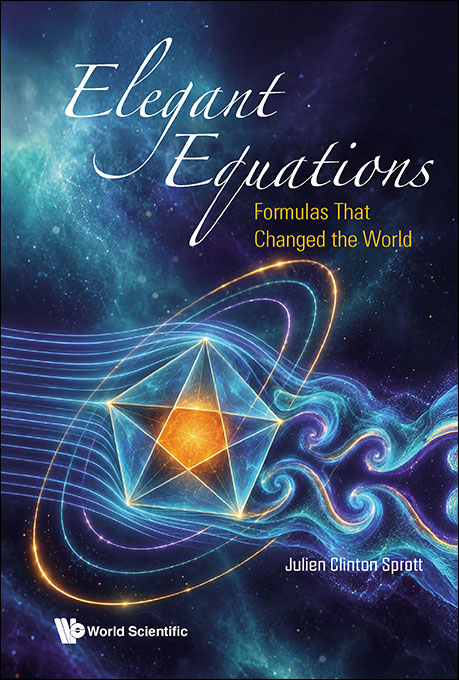
Elegant Equations
Buy from World Scientific
Buy from Amazon.com
Buy from Barnes & Noble

World Scientific, 2026 · xii + 313 pages
ISBN 978-981-98-4298-8 (hardcover)
ISBN 978-981-98-4299-5 (ebook)
DOI 10.1142/15140

Fifty famous equations, one short chapter each

From the Pythagorean Theorem and the Quadratic Formula to the Schrödinger, Dirac and Einstein Field Equations

Physics, mathematics, probability, biology and information theory: Bayes, Fourier, Navier–Stokes, Lotka–Volterra, Shannon and more

Ends with the Drake Equation and Feynman's Unworldliness Equation

Elegant Equations

Formulas That Changed the World

J. C. Sprott
Emeritus Professor of Physics, University of Wisconsin–Madison

About the Book

Elegant Equations is about fifty short equations. Each one small enough to write on a napkin, and large enough to change how we measure land, move planets, send messages, or think about chance. The book tells the stories behind those formulas — who wrote them, what problem they were trying to solve, and why a few symbols were enough. From Pythagoras's right-angled triangle and Archimedes in the bath to Newton's laws, Maxwell's heirs, Einstein's four 1905 papers, Schrödinger's waves, Shannon's bits, and Drake's question about other worlds, the equations follow the order in which they appeared. Along the way are the lives tangled in them: secret methods and public feuds, decades of calculation, ideas that could have been rejected and then found unavoidable.

The book is not intended to be a textbook, nor a museum for famous names, but it could be an argument that the world keeps yielding to compact relations, and that the people who found them were not outside ordinary life. The last chapter probes what those fifty formulas have in common and leaves the next one for the reader.

Written for students, researchers, and anyone captivated by intellectual clarity, this book demonstrates why simplicity is the ultimate strength in science. The readers will find deeper appreciation for such profound impact, inspiring them to seek elegance in their own future work.

Contents

1. The Pythagorean Theorem
2. The Law of Cosines
3. Archimedes' Principle
4. Heron's Formula
5. The Quadratic Formula
6. The Fibonacci Sequence
7. The Golden Ratio
8. Cardano's Cubic Formula
9. Napier's Logarithms
10. Kepler's Third Law
11. The Binomial Theorem
12. The Definition of the Derivative
13. Hooke's Law
14. Newton's Second Law
15. Law of Universal Gravitation
16. Bernoulli's Principle
17. Euler's Identity
18. Euler's Polyhedron Formula
19. Bayes' Theorem
20. Buffon's Needle Problem
21. Coulomb's Law
22. Fourier Series
23. Normal (Gaussian) Distribution
24. Fourier Transform
25. Navier–Stokes Equations
26. Ohm's Law
27. Faraday's Law of Induction
28. Ideal Gas Law
29. Hamiltonian Mechanics
30. Gauss's Law
31. Logistic Growth Equation
32. Second Law of Thermodynamics
33. Riemann Zeta Function
34. Boltzmann Entropy Formula
35. Stefan–Boltzmann Law
36. Arrhenius Equation
37. Prime Number Theorem
38. Planck's Relation
39. Lorentz Transformation
40. Einstein's Photoelectric Equation
41. Mass–Energy Equivalence
42. Hardy–Weinberg Equilibrium
43. Einstein Field Equations
44. Lotka–Volterra Equations
45. Schrödinger Equation
46. Heisenberg Uncertainty Principle
47. Dirac Equation
48. Shannon Information Entropy
49. Drake Equation
50. Feynman's Unworldliness Equation

Last updated October 27, 2026