 Buy from World Scientific Buy from Amazon.com Buy from Barnes & Noble
World Scientific, 2022 · 356 pages
|
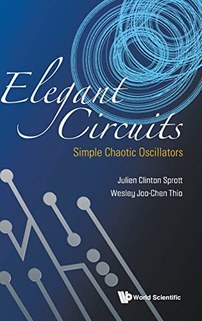
Elegant CircuitsSimple Chaotic OscillatorsJ. C. Sprott and Wesley J. ThioEmeritus Professor of Physics, University of Wisconsin–Madison Praise for Elegant Circuits
About the BookChaos is the study of the underlying determinism in the seemingly random phenomena that occur all around us. One of the best experimental demonstrations of chaos occurs in electrical circuits when the parameters are chosen carefully. This book shows you how to construct such chaotic circuits for use in your own studies and demonstrations while teaching you the basics of chaos. It should be of interest to researchers and hobbyists looking for a simple way to produce a chaotic signal, and useful to students and their instructors as an engaging way to learn about chaotic dynamics and electronic circuits. The book assumes only an elementary knowledge of calculus and the ability to understand a schematic diagram and the components that it contains. You will get the most out of this book if you construct the circuits for yourself. There is no substitute for the thrill and insight of seeing the output of a circuit you built unfold as the trajectory wanders in real time across your oscilloscope screen. A goal of this book is to inspire and delight as well as to teach. Contents
|
Last updated October 25, 2026